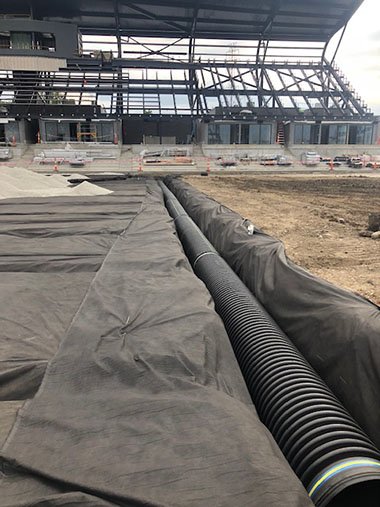
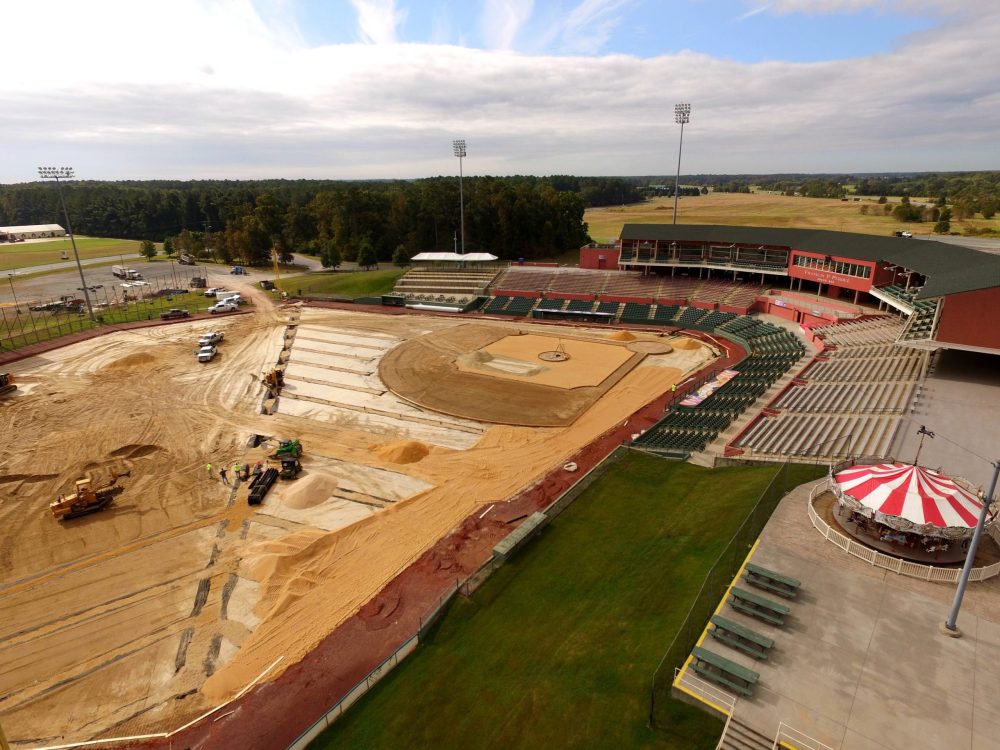
It doesn’t matter if you are building a football field, baseball field, soccer pitch, or multi-purpose sports field, drainage can be your best friend or worst enemy. Poor drainage is one of the most common problems of high use sports fields. If you take the proper steps and try not to rush the process, you can achieve a beautiful and well-draining field. However, if you cut corners on this step, you may be playing water polo on your new field instead. This is the time your soil tests will make a little more sense. Based on the outcomes of your soil tests, you may have to amend your soil early, so make sure you have a pro on your side to guide you through your field’s specifications and variables of your drainage needs. Check out this overview of important aspects of your sports field drainage project.
To begin, most surface drainage problems originate from incorrect grading and an uneven landscape. Compaction across the field is another important aspect. One of the common misconceptions of baseball infield materials and drainage is that water should pass through the skinned infield and be removed by drain lines. The infields should be graded so that the water sheets off the skin and into the turf where it can infiltrate or be collected in a drain system.
Grading the field with a center crown, rather than lateral grading, is the most effective way to remove surface water because it moves water a shorter distance. This is the raised part of a sports field that provides a slope to promote runoff of surface water. They can consist of a ‘turtleback’ or ‘pitched roof’ crown, used primarily for football-only fields, or a traditional crown, mostly used on soccer fields. Fields made of native soil typically are built with a minimum of 1½ % slope and should never be flat, whereas sand-based fields with vertical drainage are typically built with 0-0.5% slope. The soil selection and field configuration are critical to design and drainage performance. Regardless of budget and type of field configuration, you can achieve a proper grade that provides natural drainage and will still be playable for your athletes.
Once your surface drainage basics are taken care of, now you can plan for what type of drainage system you will need in addition to the natural surface drainage solutions previously mentioned.
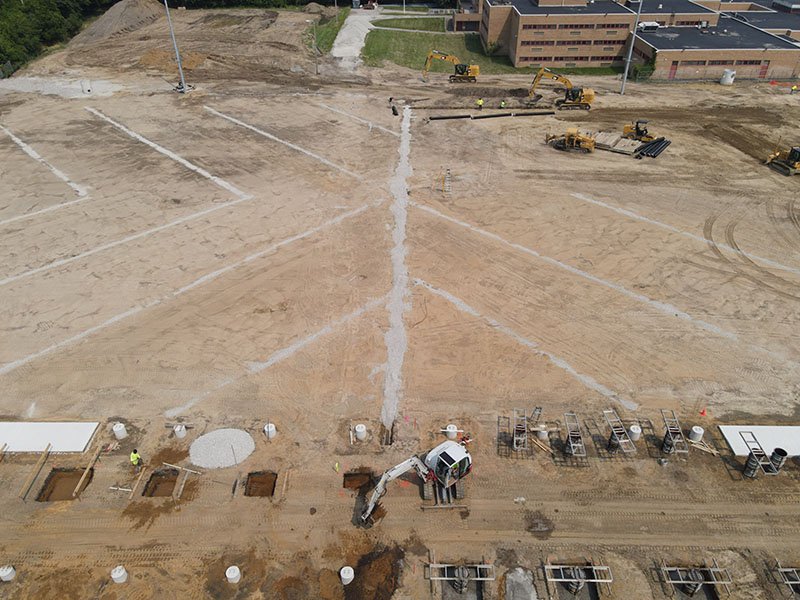
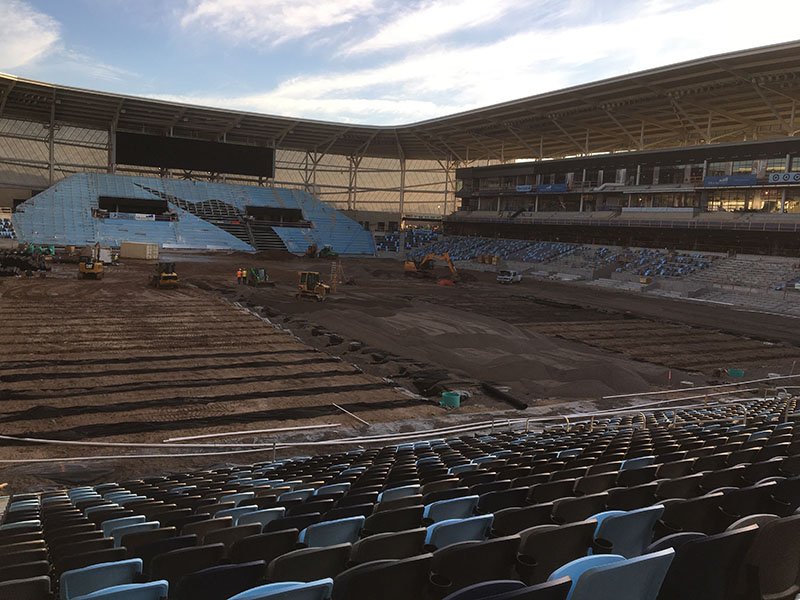
Again, this is when your soil tests will come in handy. Two of the variables you may run into is coarse soil and/or fine soil. Coarse soils like sand tend to drain better than fine soils like clay. However, coarse soils could supply too much aeration and may not be able to be compacted to your standards. There are three popular types of drainage systems used today on sports fields; pipe drains, strip drains, and sand slit drainage.
Pipe drains have been used for years and, while aiding in overall drainage, are primarily used to lower the water table in an area, allowing the surface to dry, and to hold the water as it discharges to its final location. Originally these systems used clay tile and more recently, corrugated plastic pipe. They range from 18 inches to 3 feet deep. The trench is filled with gravel or coarse sand to the field subgrade.
Next are strip drains, which are becoming much more common as a means of draining athletic fields. Strip drains are narrow trenches 2 to 4 inches wide that are cut with specialized trenchers from 8 to 18 inches deep. They are much more effective in quickly removing surface water from sports fields than pipe drains. The strip drains are connected to a perimeter collector. The collector should be sized to manage the volume of water collected from the series of strip drains. The strip drains should be placed at a 45-degree angle to the direction of the slope. This will allow them to be installed at a consistent depth and keep a slope in the pipe.
The sand slit drainage system consists of a matrix of narrow 1.75-inch-wide sand slits on 12 to 20-inch centers. These are cut 8 inches deep and intersect at 90-degree angles to a series of sub-drains installed on 10 to 20-foot centers. This system promotes rapid surface drainage with sand trenches every 12 to 20 inches to allow water to enter the drainage system rapidly. These sand trenches will also improve the aeration of the field and hold moisture in the soil profile when excess is not present.
Whatever drainage system you and your team decide to go with will be a significant part of any field manager’s budget. However, it’s so important to have a field drainage system that fits your field’s specifications and variables because anything less than a professional drainage installation could cost you big time in the future. We’re here to help you do what’s best for your field and budget.